Modern applications are composed of small, independent building blocks that are easier to develop, deploy, and maintain. Application integration services enable communication between decoupled components within microservices, distributed systems, and serverless applications so you can easily build scalable and more resilient solutions. With a suite of services for message queuing, publishing and subscribing to topics, application orchestration, and GraphQL APIs, AWS enables integration within nearly any application.
AWS Step Functions AWS Step Functions lets you coordinate multiple AWS services into serverless workflows so you can build and update apps quickly. Using Step Functions, you can design and run workflows that stitch together services such as AWS Lambda and Amazon ECS into feature-rich applications. Workflows are made up of a series of steps, with the output of one step acting as input into the next. Application development is simpler and more intuitive using Step Functions, because it translates your workflow into a state machine diagram that is easy to understand, easy to explain to others, and easy to change. You can monitor each step of execution as it happens, which means you can identify and fix problems quickly. Step Functions automatically triggers and tracks each step, and retries when there are errors, so your application executes in order and as expected.
Amazon MQ Amazon MQ is a managed message broker service for Apache ActiveMQ that makes it easy to set up and operate message brokers in the cloud. Message brokers allow different software systems–often using different programming languages, and on different platforms–to communicate and exchange information. Amazon MQ reduces your operational load by managing the provisioning, setup, and maintenance of ActiveMQ, a popular open-source message broker. Connecting your current applications to Amazon MQ is easy because it uses industry-standard APIs and protocols for messaging, including JMS, NMS, AMQP, STOMP, MQTT, and WebSocket. Using standards means that in most cases, there’s no need to rewrite any messaging code when you migrate to AWS.
to get in depth knowledge on AWS you can enroll for free live demo AWS Online Training
Amazon SQS
Amazon Simple Queue Service (Amazon SQS) is a fully managed message queuing service that enables you to decouple and scale microservices, distributed systems, and serverless applications. SQS eliminates the complexity and overhead associated with managing and operating message oriented middleware, and empowers developers to focus on differentiating work. Using SQS, you can send, store, and receive messages between software components at any volume, without losing messages or requiring other services to be available. Get started with SQS in minutes using the AWS console,Command Line Interface or SDK of your choice, and three simple commands. SQS offers two types of message queues. Standard queues offer maximum throughput, best-effort ordering, and at-least-once delivery. SQS FIFO queues are designed to guarantee that messages are processed exactly once, in the exact order that they are sent.
Amazon SNS
Amazon Simple Notification Service (Amazon SNS) is a highly available, durable, secure, fully managed pub/sub messaging service that enables you to decouple microservices, distributed systems, and serverless applications. Amazon SNS provides topics for high-throughput, push-based, many-to-many messaging. Using Amazon SNS topics, your publisher systems can fan out messages to a large number of subscriber endpoints for parallel processing, including Amazon SQS queues, AWS Lambda functions, and HTTP/S webhooks. Additionally, SNS can be used to fan out notifications to end users using mobile push, SMS, and email.
Amazon SWF
Amazon Simple Workflow (Amazon SWF) helps developers build, run, and scale background jobs that have parallel or sequential steps. You can think of Amazon SWF as a fully-managed state tracker and task coordinator in the cloud. If your application’s steps take more than 500 milliseconds to complete, you need to track the state of processing. If you need to recover or retry if a task fails, Amazon SWF can help you
The abbreviation of AWS is amazon web services. The AWS service is provided by the amazon that uses the distributed IT infrastructure to provide different resources. AWS offers flexible, reliable, easy to use, and cost-effective solutions. It provides different types of services such as software as a service(SaaS), infrastructure as a service(IaaS), and platform as a service(PaaS).
AWS started Its services to the market in the form of web services, which is now called “cloud computing”.
To get in depth knowledge on AWS you can enroll for free live demo AWS Online course
Uses of AWS:
An architectureconsulting company can use AWS to get the high rendering of the construction prototype.
A media company can use the AWS to provide different types of content such as ebox or audio files to the world wide files.
What is AWS lambda??
Lamda is used to encapsulate Data centres, hardware, Assembly code or protocols, high-level languages, operating systems AWS, etc. Lamda is a computed service where you upload your code and create the lambda function.
Upcoming Python SDK changes in AWS Lambda:
This record describes the upcoming change to the AWS SDK that provides that affects python developers using the requests module in boto-core. This post explains the why changes are happening and describe what python developers must do to continue using request library.
The upcoming changes to AWS SDK:
Botocore is the low-level interface to many services in the AWS Cloud. The package is the foundation for AWS CLI and also Boto3, which is the AWS SDK for python. In August 2018, Botocore was refactored to allow the pluggable HTTP Clients.
One of the main changes is that the request library was replaced with urillb3. Additionally, the requested dependency was also uncensored, which means botocore can supports the scope of versions of urillb3, instead of depending on specific versions. From version 1.13.0, the request module is no longer part of the AWS SDK for python. These changes create additional flexibility for python developers and can result in performance improvements for an application using Botocore.
Although the SDK has removed the requests module, the lambda services continuous to bundle the request module in the AWS SDK until march 30,2020. Hence the builder has additional time to decide on the best course of action for there python lambda functions that rely on the request module.
Best implementation for using the AWS SDK:
For benefit, the Lambda service includes the AWS SDK in its execution environment. This allows Lamda to interoperate with the growing number ofAWS services and Features released to users.
The best implementation for Lamda development is the collection of all the dependencies used by your Lamda function, using the AWS SDK. By doing this your code uses the bundled version and is not affected when the version in the execution environment is upgraded. This is preferable to using the included version of the SDK, since this version can change, and in rare cases might affect suitable with your code.
If you are currently collecting the SDK version in your Lambda version, you do not need any further action. Your code Continuous to use the bundled version and the upcoming changes do not affect you.
Import the requests module directly in your code:
If you are using the AWS SDK in the Lambda execution environment and do not want to bundle a version into your zipped deployment package, you have a couple of additional options.
First, you can install the requests module into your python environment and import the module directly. Currently, You may be importing the library from your botocore in your AWS lambda function using this code.
Python
From botocore .vendored import requests
Python
First, we install the requests module, enter the following in a terminal window:
Python
pip install requests -t./
After the installation, update the import statement in your code as shown below:
Python
Import requests
This updates your dependency from the botocore vendored version to a locally packaged version of the module. As a result, your code is unaffected after the request module is no longer available via the AWS SDK in the execution environment.
if you are interested to learn python you can enroll for free live demo Python online Training
Conclusion:
Botocore helps to improve flexibility and performance for the AWS SDK. If you are bundling a fixed AWS SDK version with your python version, you do not need to take any action. If you are using the AWS SDK included in the execution environment and want to continue using the request module, you can include the Lambda layer with the appropriate AWS SDK version, or include the requests module directly in your application package.
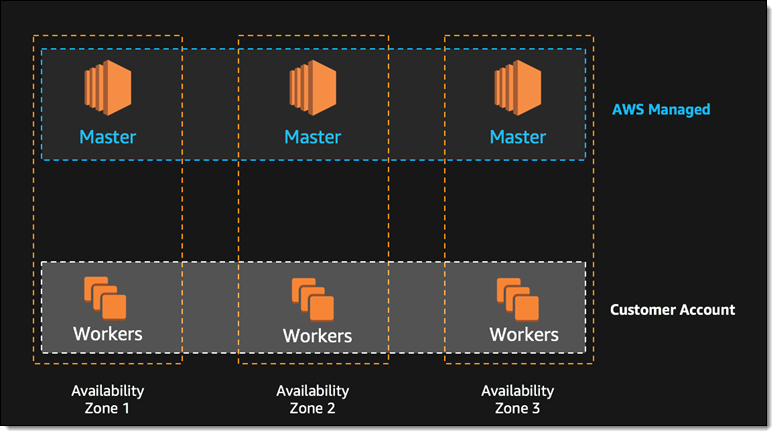
We have a lot of AWS customers who run Kubernetes on AWS. In fact, according to the Cloud Native Computing Foundation, 63% of Kubernetes workloads run on AWS. While AWS is a popular place to run Kubernetes, there’s still a lot of manual configuration that customers need to manage their Kubernetes clusters. You have to install and operate the Kubernetes master and configure a cluster of Kubernetes workers. In order to achieve high availability in you Kubernetes clusters, you have to run at least three Kubernetes masters across different AZs. Each master needs to be configured to talk to each, reliably share information, load balance, and failover to the other masters if one experiences a failure. Then once you have it all set up and running you still have to deal with upgrades and patches of the masters and workers software. This all requires a good deal of operational expertise and effort, and customers asked us to make this easier.
To get in depth knowledge on AWS you can enroll for free live demo AWS Online Training
Introducing Amazon EKS Amazon Elastic Container Service for Kubernetes (Amazon EKS) is a fully managed service that makes it easy for you to use Kubernetes on AWS without having to be an expert in managing Kubernetes clusters. There are few things that we think developers will really like about this service. First, Amazon EKS runs the upstream version of the open-source Kubernetes software, so you can use all the existing plugins and tooling from the Kubernetes community. Applications running on Amazon EKS are fully compatible with applications running on any standard Kubernetes environment, whether running in on-premises datacenters or public clouds. This means that you can easily migrate your Kubernetes application to Amazon EKS with zero code changes. Second, Amazon EKS automatically runs K8s with three masters across three AZs to protect against a single point of failure. This multi-AZ architecture delivers resiliency against the loss of an AWS Availability Zone.
Third, Amazon EKS also automatically detects and replaces unhealthy masters, and it provides automated version upgrades and patching for the masters. Last, Amazon EKS is integrated with a number of key AWS features such as Elastic Load Balancing for load distribution, IAM for authentication, Amazon VPC for isolation, AWS PrivateLink for private network access, and AWS CloudTrail for logging.
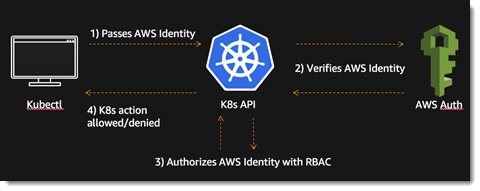
How it Works Now, let’s see how some of this works. Amazon EKS integrates IAM authentication with Kubernetes RBAC (the native role based access control system for Kubernetes) through a collaboration with Heptio.
You can assign RBAC roles directly to each IAM entity allowing you to granularly control access permissions to your Kubernetes masters. This allows you to easily manage your Kubernetes clusters using standard Kubernetes tools, such as kubectl.
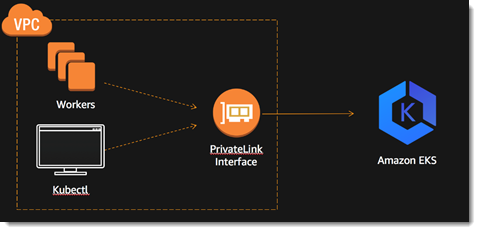
You can also use PrivateLink if you want to access your Kubernetes masters directly from your own Amazon VPC. With PrivateLink, your Kubernetes masters and the Amazon EKS service endpoint appear as an elastic network interface with private IP addresses in your Amazon VPC.
This allows you to access the Kubernetes masters and the Amazon EKS service directly from within your own Amazon VPC, without using public IP addresses or requiring the traffic to traverse the internet.
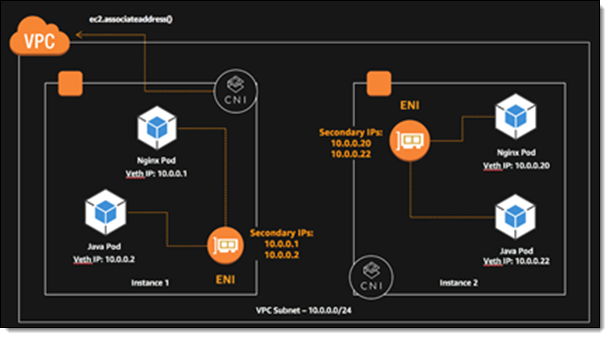
Finally, we also built an open source CNI plugin that anyone can use with their Kubernetes on AWS. This allows you to natively use Amazon VPC networking with your Kubernetes pods.
With Amazon EKS, launching a Kubernetes cluster is as easy as a few clicks in the AWS Management Console. Amazon EKS handles the rest, the upgrades, patching, and high availability.
For many years Amazon’s cloud platform AWS (Amazon Web Services) has been the champion in the cloud marketplace. Only in the last few years has Microsoft’s Azure platform started to challenge the dominance of AWS in terms of total revenue booked, though AWS still reigns supreme in the IaaS (infrastructure-as-a-service) category of cloud services. But the times they are a-changin’, as the old Bob Dylan song says, and Amazon’s long-time position on the top of the heap has resulted in challenges arising from cloud vendors who until now have been considered underdogs. What seems to be happening now is that some smaller vendors are partnering up to try and challenge AWS and the result has been an increase in the intensity of the Cloud Wars. To gain some insight into what’s currently happening and what may lie ahead, I recently talked with a couple of experts who have a handle on the cloud marketplace.
AWS cloud: A nice head start
I started by talking with Todd Matters, the chief architect and co-founder at RackWare, a company that offers a Hybrid Cloud Management Platform that helps enterprises migrate to the cloud & protect their workloads. I asked Todd why is AWS still considered the “big kahuna” in the cloud computing marketplace and what qualities make them the “top dog” that everyone else is gunning for. “AWS was the first vendor in the market by quite a big margin,” Todd said. “It really pushed the envelope in terms of the features, services, and options that were offered. AWS was also very good at providing very attractive entry-level pricing. But by the time enterprises purchase the different services that are necessary, AWS is not necessarily less expensive than the other clouds. AWS looks very attractive to enterprises initially, so they tend to get a lot of attention.”
I mentioned to Todd that one of the reasons that several large enterprises I have contact with decided to go with AWS initially was because they have datacenters all over the world. “Yes, AWS also has many datacenters dispersed very strategically throughout the world,” Todd says, “and by doing this people can take disaster recovery into consideration because there’s always a datacenter someplace that they can take advantage of.” And, of course, disaster recovery, is one of the key things you need to take into consideration when you decide to host your workloads and data in the cloud instead of having it in-house where you have more control.
To get in depth knowledge on AWS you can enroll for free live demo AWS Online Training
Playing catch up
Another reason many companies I have familiarity with have chosen to go with AWS is because of the breadth of features available in the platform. Asked whether there are any features that AWS has that competitors are still playing catch up on, Todd replied “AWS’s object storage is still a big advantage. It is a very practical solution that solves a lot of storage needs and is also very cost-effective. But Amazon has impressive feature sets in essentially every area,” emphasizes Todd, “from Kubernetes to containers. It may be a little bit of work, but enterprises can implement disaster recovery and auto-scaling. AWS’s list of services and features is almost astounding. There’s basically something for pretty much everybody.”
The biggest news in recent days concerning the Cloud Wars is, of course, the news that IBM has closed its acquisition of Red Hat for the huge sum of $34 billion. Another expert I talked with, Tim Beerman, CTO at Ensono, a company that offers managed services for mainframe, cloud, and hybrid IT, offered up the following thoughts about the acquisition. “IBM’s acquisition of Red Hat is a big win for the companies and their customers. Red Hat’s technology will help modernize IBM’s software services, IBM’s investment will help Red Hat scale its offerings, and customers will be able to go to market faster. Now that this partnership is finalized, we’ll begin to see more opportunity for hybrid IT, as companies that are hesitant to move their workloads to the public cloud will have the option to add an open source layer and manage their data across multiple clouds. The added security and flexibility of hybrid IT allows businesses to keep up with evolving cloud computing capabilities, receive more competitive pricing and see results faster.”
Teaming up to take down No. 1
On top of IBM’s deal to acquire Red Hat, however, is the earlier announcement from Microsoft and Oracle that they were going to partner by making their cloud platforms interoperable with each other. When I went back to Todd and asked him what he thought were the underlying strategies behind both Microsoft partnering with Oracle and IBM acquiring RedHat, he suggested that “the cloud providers are playing to their strengths right now. For example, Microsoft has its own software and by partnering with Oracle Cloud Infrastructure, they can be more competitive in the industry without really threatening their core cloud business. In turn, Oracle has an opportunity to increase their revenue by providing services where they are the dominant leader.” So, in other words, these changes in the cloud marketplace aren’t just happening because the vendors involved believe in the idea that bigger is better. Instead, there is more at play here. “Because they can be mutually beneficial,” says Todd, “we are going to see more kinds of those partnerships moving forward.”
So how then is this intense competition happening between top cloud vendors going to impact their enterprise customers? Will it all be good, or will there also likely be some problems? I asked Todd this question and he replied that “competition among the cloud vendors will always be good for customers. It will continue to drive down prices, increase innovation and solve real problems for enterprises.” Let’s cross our fingers and hope that this is the case because the big fish are getting bigger and fewer when it comes to cloud services vendors.
AWS IoT Core is a cloud platform by Amazon Web Services, in which connected devices can interact with cloud applications, and other devices easily and in a secure manner.
It helps many devices, send and receive messages, take actions and direct those notifications to endpoints and to other devices accurately and securely.
By using AWS IoT, our applications can maintain a record, and interact with all our devices even when they are not connected.
With the help of Amazon Web Services IoT, We can use easily Amazon Web services like AWS CloudTrail, Amazon CloudWatch, Amazon DynamoDB, Amazon S3, and Amazon Kinesis to create IoT applications that collect, operates, examine and act on data produced by connected devices without managing any framework.
How does AWS IoT Core Works?
Connect and maintain your devices:
AWS IoT Core makes us connect easily any number of devices to the cloud and to other devices. It helps Websockets, HTTP and MQTT, a less weight interaction protocol mainly built to handle disconnected connections, reduce the code in devices, and decrease network bandwidth necessities.
to get in depth knowledge on AWS you can enroll for free live demo aws online course
Protect Device Connections and data:
Amazon Web Services IoT gives confirmation and completes encryption among all connection points. By which the data is never transferred, among devices and Amazon Web Services IoT without any proven identity.
We can also protect access to our devices, and applications by implementing policies with small permissions.
Process and act upon device data:
Using Amazon Web Services IoT, we can separate, change, and take action on-device data on the fly, depending on the business rules we specify.
We can update our rules to execute a new device, and application properties at any time. With Amazon Web Services IoT, it is easy to use Amazon Web services like Amazon S3, Amazon CloudWatch, Amazon DynamoDB, and Amazon Kinesis for powerful IoT applications.
Read and set the device state at any time:
It saves the fresh state of a device, by which it can be read or fix at any time, enabling the device to display to our applications as online always.
Even if your application is disconnected, we can read the state of the device and can set the device state, and it is applied when the device connects again.
Features of AWS IoT Core:
Alexa Voice Service (AVS) Integration:
Alexa integration is a group of devices, designed using Alexa Voice Service (AVS) which has a speaker and a microphone. We can communicate with these products directly, using the starting word “Alexa”, and get voice replies and text immediately.
Rules Engine:
Rules Engine helps to create IoT applications that collect, process, examine and take action on data produced by interlinked devices, on a broad scale without managing any infrastructure.
Device Shadow:
Using AWS IoT Core, we can design a constant, practical version, or Device Shadow, of every device that consists fresh state of the device.
By which the applications and other devices can read notifications, and communicate with the device.
Registry:
The Registry starts an identity for devices and records metadata, like device features and abilities. It also gives a unique identity to every device that is continuously patterned, no matter how it connects and which type of device it is.
Authentication and Authorization:
AWS IoT Core delivers common authentication and encryption, at every point of connection, so the data will not be exchanged between devices and AWS IoT Core without any proof.
Message Broker:
The Message Broker is a high output or sub-message mediator, that transfers messages safely to and from all of our IoT devices and applications, with less latency. We can send or receive messages from many devices, because of its adaptable nature.
Device Gateway:
It serves as the starting point for IoT devices, connecting to Amazon Web Services. It manages all active device links and executes semantics, for different protocols to make sure that devices communicate with AWS IoT Core efficiently and securely.
AWS IoT Device SDK:
We can connect our hardware device or our mobile application to AWS IoT Core, easily and fastly with the help of Amazon Web Services IoT Device SDK. This also helps to connect, authenticate, and transfer notification with AWS IoT Core by using the HTTP, MQTT, or WebSockets protocols.
In this article, I have shared about AWS IoT Core. Follow my articles, to get more updates on Amazon Web Services.
For sending the Files from On-premises toAWS, we have to follow the below steps.
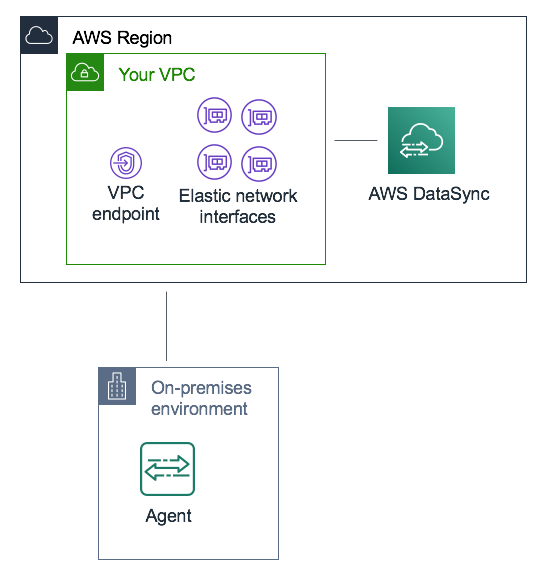
Select the VPC and subnet, where you want to set up Data sync IPs. This is like a VPC, that goes through your Dashboard, with Help of Routing Terms, over Direct Connect or VPN. Every communication in between your Data sync agent and Service stays constant in this VPC.
2. Move a Data sync client on-premises, from where it gets access to store location with the help of SMB and NFS. OVA is like Agent deployment will be downloaded, from the Data sync console. Your Agent won’t require a public IP.
To get in depth knowledge on AWS You can enroll for free live demo AWS Online Training
3. Design a Security Group, that which requires exact access to the private IPS Data sync. For Data Transfer four ENIS, that are used for Data Transfer. The Security Group handles access to these private set IPS. They make sure that your agent can route them.
Since the agent Require a set of Established one, to these IPs, you can configure inbound rules, that allow their agent’s IP, a private one for connecting IPs Data Sync uses, The agents have to communicate to ports 1024-1064,443 and the port 22.
4) Design an AWS VPC endpoint, for Data Sync Service. In the Amazon VPC console, we have to select AWS Service. For this Service Name Select, DataSync, in your Location. After that you have to select an aws VPC and a Security Group, so you can select the First and third steps, in standard and you have to uncheck the private DNS name.
5. In the Final point of AWS VPC, your Design is available, you have to make sure that the network communication, for your on-premises dashboard, accepts your agent activation.
Activation is the only operation that associates the agent, with your AWS account. For activating the agent, you can use a computer, that reaches the agent with port 80.
After activating this will be revoked. The agent can able to reach the private IP of the aws VPC final point, you have designed in step four. For recognizing step 4. For finding this IP, you have to navigate to the AWS VPC console and select the Endpoints from the navigation section.
Choose the Data sync’s final point and look into the subnets. There you can Identify private IPs, that correspond to the subnet you have to select.
7. Select the Get key, and in an option enter an agent name and tag and select design Agent. Your new agent is now more visible in the agents’ tab of the Data sync console.
The green AWS VPC Endpoint banner shows that all skills and tasks are operated with an agent, they use private endpoints, without changing the public Internet.
8. Design your task by setting a source and a destination for transferring your Data.
9. For facilitating transfer with the guidance of certain private IPS, you can design four elastic network interfaces. With that In remaining, in AWS VPC and the subnet, that you select.
You have to make sure, that your Agent can reach them, for finding these IPs, you have to navigate to Amazon EC2 Console. And select the network interface button, on the left.
After that enter the task ID into the Search filter, to see 4 ENIs for the work. You have to allow the outbound traffic, from the agent for this ENIS with the help of 443.
As we have to go with Data sync is a service, that launched in Re: invent 2018. By that, we can automate and transfer Data in a faster way, in between the storage and AWS.
With Amazon Elastic file system and Amazon s3. We have recently expanded the service for supporting Direct transfer for all S3 storage classes. So many users are using Data Sync for migrating on-premises storage to us. In point to turn off the Datacenters.
Or we can move cold data to many cost-effective storages. Data Syncadheres to high standards of data with complete data centers. Or we can move more cost-effective storage.
Benefits
Data Sync accepts you to configure, certain source of location, with on-premises and a Destination in Amazon storage service. It also uses a certain purpose for designing network protocol and many others.
I think I have provided the best about this Topic and in upcoming articles, I will update more data on AWS updates.
Both Amazon EC2 Container Service (ECS) and Kubernetes are fast, highly scalable solutions for container management that allow you to run containerized applications in a cluster of managed servers.
Kubernetes, an open-source container management solution, was first announced by Google in 2014. Its design is influenced by Borg, a highly scalable container management system, which is used by Google internally. After the Kubernetes 0.1 release in July 2015, Google donated Kubernetes to the Cloud Native Computing Foundation. Since then, several stable versions have been released under Apache License.
to get in depth knowledge on AWS You can enroll for free live demo AWS Online training
Released in November 2014, soon after Google announced their Kubernetes based Container Engine, Amazon EC2 Container Service (ECS) allowed using the existing infrastructure of EC2 instances to deploy and manage containers. With other AWS features like, for example, tags and security groups, slowly but surely the container become a key building block similar to an EC2 instance and S3 object in every Amazon cloud environment.
In this article, we will discuss what they have in common and how they differ.
Usage And Pricing Actually, an unbiased comparison of Amazon ECS and Kubernetes is hard: ECS is just another Amazon service and it should be used only with other Amazon services, such as IAM, and EC2. Kubernetes, on the other hand, is an open-source solution, which can be used on the top of Amazon EC2 instances, Google Compute instances, or even on-premises. Therefore, a key aspect of this discussion is whether to use AWS infrastructure or not.
The common feature of ECS and Kubernetes is that both of them can work on a cluster of Amazon EC2 instances. ECS installs an agent on every EC2 instance that is part of an ECS cluster. Kubernetes clusters can be also installed on AWS EC2 instances, but the similarity with ECS ends here: ECS works only on top of EC2 and Kubernetes can work with other providers, such as Google Cloud and Microsoft Azure, and, as we already mentioned, in your own data center. It also worth mentioning that Google Container Engine can provide a deployed Kubernetes cluster in the same vein as Amazon provides ECS cluster. The key difference is that Kubernetes is open and vendor-agnostic with respect to the underlying infrastructure.
The price model is similar for ECS and Kubernetes because both use the underlying compute instances, and you only pay for those instances.
Availability and Scalability ECS is aware of multiple Availability Zones. As long as EC2 instances are configured to use multiple Availability Zones, ECS will try to distribute containers to maintain high availability. Google Container Engine provides a similar feature for Kubernetes, but the situation is completely different is you decide to install it on your own (“do-it-yourself”). Kubernetes clusters can be installed on top of Amazon EC2 instances, or on top of compute instances of other cloud provider, or using your own data center. Kubernetes multi-site HA is possible, and there are several deployment tools that can help you with that. Nonetheless in general, you should take care of that yourself.
Interoperability vs. Vendor Lock-in Amazon ECS is tightly integrated with other Amazon services, however there are two sides to this story.
On the one hand, ECS does exactly what it is designed for – it manages containers – and it relies on other Amazon services, such as Identity and Access Management (IAM), Domain Name System (AWS Route 53), Elastic Load Balancing (ELB), and EC2. Each service does one thing and you need to use all of the required services for your application. This allows using the familiar concepts such as Security Groups, IAM policies to manage your containers. Integration with other Amazon services also gives you additional benefits. For example, ECS allows to run a custom Docker registry based on S3.
On the other hand, it creates a lock-in to Amazon cloud. For example, you have to use IAM policies and Security Groups, if you want to use ECS. Also, the recommended way for service discovery with ECS is to use ELB. This can be a problem, because even for a single service you have to use an ELB to make the service discoverable. For microservice architectures, this creates an additional overhead every service you deploy.
At the same time, Kubernetes is designed to be as much modular as possible. It supports different load balancers (for example, you can use the existing load balancer in your network), network models (OpenVSwitch, Flannel, Calico are the well-known examples of the network models), volumes. Kubernetes is also designed to support different container engines (runtimes). Docker is the default and most tested container runtime for Kubernetes, however there is an implementation that enables support of rkt containers. ECS supports only Docker containers at the moment.
It’s worth mentioning that the ability of Kubernetes to work on a pool of regular AWS EC2 instances and use S3 and EBS for objects and volumes respectively brings an interesting opportunity: even if you use AWS, you can start using Kubernetes on AWS as well, keeping in mind that applications managed by Kubernetes can be transferred from AWS to other Kubernetes cluster, for example, installed on premises, if necessary.
Features Comparison As we already mentioned, it is hard to compare features of ECS and Kubernetes directly, because ECS relies on other Amazon services such as IAM, ELB, EC2 and it is practically impossible to use ECS independently. At the same time, Kubernetes provide a complete managed execution environment and in most cases you have a choice, which open-source components to use for a specific implementation. For example, with Kubernetes you have a choice for a network model (for example, OpenVSwitch, Flannel, or Calico), for a persistent storage (for example, Ceph, GlusterFS, or NFS) and so on.
Common Features Both ECS and Kubernetes support Docker containers, they can be installed using a pool of vanilla EC2 instances, they can use S3 for object storage, and EBS for volumes. Both support a required set of operations with containers, that is usually from the container management solutions. Both have command line and graphical interfaces (AWS Console and Kubernetes Dashboard correspondingly).
Features Specific to Amazon ECS ECS is aware of multiple Availability Zones out of the box. Using a rich set of functions provided by other Amazon services in several cases you can achieve the required result faster and simple.
Features Specific to Kubernetes The key Kubernetes feature is the ability to install a Kubernetes cluster on various cloud instances, including AWS, Google Cloud, Azure, and OpenStack. Kubernetes cluster can be also installed on premises. Kubernetes’ pluggable architecture allows using different network models, storages and even container engines: Kubernetes supports, for example, rkt containers.
As we already mentioned, Kubernetes is more than a container management solution. It provides a complete managed execution environment for deploying, running, managing and orchestrating containers. Several features, such as auto scaling and auto healing using cluster- or application-specific probes, are unique for Kubernetes and bring it close to the solutions such as AWS Lambda.
Some container management features of Kubernetes does not have ECS-specific limitations. For example, ECS does not allow multiple containers exposing the same port on the same node. Also there is an opinion (potentially subjective) that Kubernetes CLI is more comfortable than ECS CLI.
In addition to the auto scaling and auto healing features we mentioned above, Kubernetes has unique features such as Kubernetes Secrets and Config Maps to store credentials and configuration files correspondingly and share them among containers. ECS does not support secrets directly, however it is possible to encrypt secrets using Amazon Key Management Service (KMS) and decrypt them in containers. In ECS, there is no direct alternative for Kubernetes Config Maps as far as we know. It does not have a way to pass configuration to a container other than with environment variables, and the only way to specify the same values for several containers is to copy and paste them.
Summary Both ECS and Kubernetes are fast, highly scalable solutions for container management. ECS is an AWS services and well integrated with other AWS services such as Route 53, ELB, IAM, and EBS. Such tight integration enables you to get your application deployed and running simpler and faster in some cases. It does come with a drawback – once started with ECS you have to use Amazon services for everything.
On the other hand, Kubernetes is more than a container management solution. It provides a complete, managed-execution environment for deploying, running, managing and orchestrating containers. The key advantage of Kubernetes is that it can be installed on a variety public and private clouds (AWS, Google Cloud, Azure, OpenStack) and on premises. Kubernetes can be installed on a cluster of AWS EC2 instances and it can use AWS S3 and EBS for volumes, therefore AWS users can start using Kubernetes on AWS, with the option of moving applications managed by Kubernetes to another cloud provider or an on-premises data center.
Kubernetes has pluggable architecture and, as a result, can use different open-source solutions for a network model (OpenVSwitch, Calico) and storage (Ceph, GlusterFS, NFS). Some features, such as shared secrets, config maps, auto scaling and auto healing of containers using cluster- and application-specific probes, are unique to Kubernetes and bring Kubernetes closer to such solutions as AWS Lambda, which became popular recently.
It’s time to dispel a common major myth about the Google Cloud Platform (GCP) as it relates to Amazon Web Services (AWS). Despite what many believe, Google is not “new” to the cloud. In fact, Google’s cloud infrastructure predates Amazon’s; for years, Google used it for all of its internal projects, including Google Search, Gmail, and YouTube. GCP simply allows other enterprises to take advantage of the same time-tested cloud services that Google has relied upon for years.
GCP is not just an alternative to AWS, but a far superior choice, especially with regard to cybersecurity and disruptive technologies such as artificial intelligence (AI) and machine learning (ML). Let’s examine some of the key areas in which GCP has AWS beat:
To get in depth knowledge on AWS you can enroll for free live demo AWS Online Training
Artificial Intelligence & Machine Learning AWS integrates with popular big data tools and offers a serverless computing option, but Amazon’s core competency is retail. Google’s core competency is artificial intelligence and machine learning.
Google developed and is continuously refining its own AI chip, the Tensor Processing Unit (TPU), which was built specifically for machine learning and offers accelerated neural network computation that enables faster, more accurate training of ML models. Google uses the TPU to power a number of its own services, including Gmail and Google Search. Amazon offers no equivalent to the TPU.
Google’s research division, Google AI, employs a team of engineers devoted to using AI to solve both internal business problems and problems far-flung from Silicon Valley. Google is committed to making AI accessible to all. Its engineers frequently author academic research papers to publicly share their findings, and Google open-sources its AI/ML tools.
Cybersecurity is another critical area where Google is leveraging AI/ML to solve business problems. Chronicle, a subsidiary of Google’s parent company, Alphabet, was born out of Alphabet’s X “moonshot” factory. Staffed by the industry experts who developed and run Google’s own cybersecurity infrastructure, Chronicle will leverage Google’s AI/ML expertise and “near limitless compute” power to develop a world-class security analytics solution.
Cybersecurity Since the world’s most popular search engine is also the world’s biggest and most popular cyber attack surface, no one understands the real-time threat environment as well as Google’s cybersecurity engineers.
To help employers grapple with the ongoing cybersecurity skills shortage, Google has gone out of its way to make its GCP security controls as easy to use as possible. By default, GCP encrypts all data in transit between Google, its customers, and its data centers, as well as all data in GCP services and stored on persistent disks. In AWS, data encryption is available, but not by default. This is a major potential vulnerability; many successful cloud cyber attacks have been traced back to misconfigured cloud servers.
Google Cloud also allows developers to encrypt cloud applications at the application layer, for the highest levels of data security. The Cloud DLP tool makes it easier for users to identify and manage sensitive information, including the ability to redact sensitive data from text streams before writing to disk, generating logs, or performing analyses.
Google’s commitment to cybersecurity extends to its hardware. The company is the third-largest server manufacturer in the world, but they do not sell their servers; they build them solely for internal use so that they have complete control over the build process.
Costs Budget-friendly pricing is one of GCP’s main selling points, with its Cloud Platform Committed Use and Sustained Use Discounts offering significant cost savings over AWS, with no upfront costs. Google’s pricing structure is also far less complex than AWS, which is infamous for difficult-to-decipher invoices filled with hidden costs. Google’s always-free tier is also more robust than AWS, including 28 frontend instance hours and 9 backend instance hours per day on the Google App Engine, 5GB of Regional Storage on Google Cloud Storage, and 1GB of storage on Cloud Firestore, GCP’s NoSQL document database.
Google Cloud Platform also allows for the abstraction of cloud technologies from memory-sucking virtual machines to modern platforms that facilitate “just right” microservices that significantly reduce wasted cloud spend. As an example, instead of running 400 virtual machines, each with 75% utilization (the equivalent of 100 of those VMs going unused), GCP users can deploy 4000 Docker containers running in perfect orchestration via Google Kubernetes Engine, each with 95% utilization
Open Source Capabilities While Amazon has built many of its commercial services on top of OSS – Amazon’s EC2 IaaS platform is built on top of the open source hypervisor Xen – Google is one of the largest contributors to OSS, having created over 2,000 open source projects in the last decade. Google’s OSS contributions include developing Kubernetes, a popular container orchestration system that competitors AWS and Azure use, and TensorFlow, an OSS library for numerical computation that Google’s Tensor Processing Unit was built to utilize.
Kubernetes & DevOps AWS offers Kubernetes services, but Google developed Kubernetes. Google Cloud Platform users get to access new Kubernetes features and deployments immediately, while rollouts on AWS are delayed. Google Kubernetes Engine (GKE), generally considered the gold standard for running Kubernetes, is easier to use than Amazon EKS, especially for developers who are new to Kubernetes or containers. Google’s home-field advantage with Kubernetes makes GCP an attractive choice for DevOps organizations.
Competitive Concerns As Amazon adds new products and services entering into new verticals, their customers are becoming more concerned about competition. Businesses in the retail sector and other verticals that directly compete with Amazon are moving away from AWS because they do not wish to “feed the beast” by contributing to a competitor’s bottom line. Concerns over Amazon introducing a file-sharing service were among the reasons why Dropbox decided to migrate most of its cloud computing away from AWS. New Google Cloud CEO Thomas Kurian, sought to allay customers’ fears about competition during his first public appearance, promising, “Google is very clear that we’re here to enable partners; we’re not here to compete with partners.”
In this modern era, organizations running on Cloud can face severe threats from hackers at any time. Data breaches happen daily, and business has a responsibility to their customers to protect their data. They must protect against data theft or security breaches. Businesses are facing many challenges related to security like:
To get in depth knowledge on AWS you can enroll for free live demo AWS Online Training
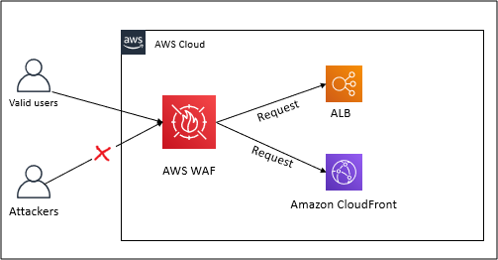
Data Privacy Integrity, Non-authentication and Non-Repudiation Online attacks like phishing, man-in-the-middle attack, DDoS, SQL injection, Phlashing, etc. That is why, it is crucial for businesses to protect their Cloud infrastructure before it gets hacked. So, there should be a safe and complete system dedicated to securing the Cloud infrastructure. In this post, we will focus on the AWS services that help businesses to protect their AWS infrastructure and their relevant use-cases.AWS WAFWhat is WAF? AWS WAF is a Web Application Firewall that monitors web request which is forwarded to Application Load Balancer (ALB), Amazon API Gateway or CloudFront. AWS WAF can also allow or block any web request as per your rules and conditions. That means your WAF sits above CloudFront or ALB so, if you don’t have these services on your infrastructure then you cannot use AWS WAF.
When to choose WAF?
AWS WAF can allow or block only the web request so, if you want to block the web request, WAF is the right choice for you. AWS WAF works with rules and conditions for the web request.
For example: If you want your CloudFront or load balancer to serve content for public requests, but also want to block requests from attackers then WAF can help you. Sometimes you see some of the web requests with one IP’s continuously hit the website, in this case, you can use WAF to block those IPs.
WAF’s another feature is it allows you to count the requests that match the properties you specify. So, if you want to allow or block any of the requests based on new properties on the web request, you can use AWS WAF. WAF helps to count the request based on those properties and once you become confident then you can allow or block those requests. This helps you to avoid accidental blocking of traffic to the website.
AWS WAF
AWS SHIELD What is AWS Shield? AWS Shield is a managed Distributed Denial of Service (DDoS) protection service that safeguards applications running on AWS. There are two tiers of AWS Shield – Standard and Advanced.
You can use AWS Shield-standard with no additional cost. AWS Shield standard defends against the most common DDoS attack that targets your website or applications.
When to choose AWS Shield and its types? You can use AWS WAF to help minimize the effect of DDoS attack so when to use AWS Shield? AWS Shield standard is automatically included with no extra cost but if you need extended protection against DDoS attack for your Amazon Elastic Compute Cloud instances, Elastic Load Balancing load balancers, Amazon Cloud Front distributions, Amazon Route 53 hosted zones, and your AWS Global Accelerator accelerators than you can use AWS Shield Advanced.
If you have the technical expertise and want full control over monitoring for and mitigating layer 7 attacks, AWS Shield Standard is likely the appropriate choice. But if your business or industry is a likely target of DDoS attacks, or if you prefer to let AWS handle most of the DDoS protection and mitigation responsibilities for layer 3, layer 4, and layer 7 attacks, AWS Shield Advanced might be the best choice.
AWS INSPECTOR
What is AWS Inspector? Amazon Inspector is an automated security assessment service that helps to make better security and compliance of applications deployed on AWS. Amazon Inspector automatically assesses applications for vulnerabilities and deviations for best practices and provides a list of security issues. Amazon Inspector Assessment is done on each EC2 instance to verify the security best practices. AWS Inspector is tag based and the agent-based security assessment service. The Assessment template looks for EC2 instances with specific tags to identify Assessment targets.
When to choose AWS Inspector? AWS inspector is an IDS (Intrusion Detection System) which helps you to detect the vulnerabilities in your application. It only detects and provides you with the assessment report and the prevention should be done by yourself. It provides you the report on how vulnerable is your application. If you feel there is some memory leakage in your application, then AWS Inspector can help to find out for you. If you find there is no encryption happening when data in transit, you can use this service to find out the cause. Also, if you want to analyze the network configuration to find the accessibility of EC2 instances, then AWS Inspector is the best service for you.
Amazon GuardDuty What is GuardDuty? Amazon GuardDuty is an intrusion detection service that monitors for malicious activity and unauthorized behavior to protect your AWS accounts and workloads. It uses threat intelligence feeds, such as lists of malicious IPs and domains, and Machine Learning to identify unexpected and potentially unauthorized and malicious activity within your AWS environment.
When to choose Amazon GuardDuty? As an intrusion detection service, Amazon GuardDuty helps in issues like escalations of privileges, uses of exposed credentials, or communication with malicious IPs, URLs, or domains. If you want to detect compromised EC2 instances serving malware or mining bitcoin, unauthorized infrastructure deployments like instances deployed in a region that has never been used, password policy change, unusual API calls, etc. Amazon GuardDuty is the best service to be used.
Amazon GuardDuty can be enabled with no software or hardware to deploy and maintain.
AWS Key Management Service (KMS) What is KMS? AWS Key Management Service (KMS) makes it easy for you to create and manage keys and control the use of encryption across a wide range of AWS services and in your applications. AWS KMS is integrated with AWS CloudTrail to record all API requests, including key management actions and usage of your keys. AWS KMS is integrated with AWS services to simplify using your keys to encrypt data across your AWS workloads.
When to choose KMS? KMS is a fully managed service that makes it easy to create and control encryption keys in AWS.
KMS utilizes symmetric encryption which means that the same key is used for encryption and decryption. If you want an extra layer of security while Data at Rest, then KMS is the best option for you. Amazon KMS is integrated with almost all the AWS services.
When you encrypt your data, your data is protected, but you must protect your encryption key. AWS KMS also helps to encrypt your plain text data with data key and encrypt the data key with another key. This is called as Envelope Encryption.
AWS Re:Invent is a one time a year super Event, where it releases new services and holds 2,500 Developer sessions for Designers, CIOs, channel and Ecosystem systems that communicate with, clients, and Industry Experts. It’s a Big Event at 65,000 participants, could be a lot bigger as it sells out following a couple of days.
The Event is straight forward. It’s the most significant cloud show, you can visit and users need to practical knowledge with the best in class, of what AWS brings to us.
To get in depth knowledge on AWS You can enroll for free live demo AWS Online Training
AWS made many declarations and keeping in mind that the Moor Insights and Strategy expert group, will be going further on the most significant AWS Re:Invent.
In this Blog we are Going Discuss the top Five Re: Invent launches of AWS:
1) EC2 Image Builder.
2) Many new Hybrid Offerings
3) Amplify Framework.
4).Sage Maker Studio.
5).No ML experience required AI Services.
1) EC2 Image Builder EC2 Image Builder is like help that, makes it simpler and quicker to combine and keep safe container pictures. It makes simple the creation, fixing, testing, and sharing of Linux or Windows Server pictures.
Before, making custom container Images felt a more critical and time-wasting Process. Most dev groups needed to physically refresh VMs or Automate Scripts to keep up these Images.
Today, Amazon’s Image Builder administration improves this procedure by accepting you to make custom OS Images by means of an AWS GUI Software. You can make it simple to program a pipeline that simplifies, tests, and circulates your images, and to keep them secure and up-to-date.
2) Many new Hybrid Offerings AWS introduced this idea and multiplied down on it. In case you’re a client who needs a low waiting experience local with Outposts, minimum waiting in public cloud with Local Zones, or in the center carrier Network with Wavelength, AWS has you secured.
When we add this to what is AWS is initiate with AWS snowball, and where it was going. It is very tough, for me to say that AWS does not, own the big diverse hybrid play.
3.Amplify Framework The Amplify Framework (open source project for building cloud-empowered Mobile and web applications) is made for iOS and Android developers. At present Amplify iOS and Amplify Android libraries for designing adaptable and secure cloud-controlled serverless applications.
Developers would now able to include Analytics, AI/ML, API (Graph QL and REST), Data Store, and Storage to their smartphone applications with these new iOS and Android Amplify libraries.
This release guided for the Predictions category to Amplify iOS that accept software to simply include and arrange AI/ML uses cases with not many lines of code.
This enables developers to get other use instances of translating Text, speech to text generation, recognizing images, text to speech, results from content, and etc.
4.Sage Maker Studio Machine Learning is hard without a Bond of Data Scientists and DL/ML Developers. The problem is that these skills are more expensive, difficult to pull and hold, also the need to have a single remarkable system like GPUs, FPGAs, and ASICs.
AWS did a great deal with its base ML administrations to help in solving the framework. And Sage Maker to communicate with the design, preparing, and sending ML at scale.
5.No ML experience required AI Services Amazon Kendra reinvents endeavor companies by using NLP ( Natural Language Processing ) and other AI systems to join many Data warehouses inside a project and it continuously gives great Results to basic Queries. Amazon Code Guru enables programming designers to program code audits and differentiates an application’s most costly lines of code.
AWS Fraud Detector guides companies with differentiating on the web identity and fraud payments in real-time values. In view of a similar technology designed for Amazon
AWS Transcribe Medical offers healthcare insurance suppliers, which is a highly accurate, real-time speech to text transcriptions. So they can concentrate on patient Medical care.
Generally, Amazon Augmented Artificial Intelligence (A2I) helps machine learning designers approve AI Programs through human Approval.
These are the best AWS Re:Invent Launches in 2019. There are many Re: Invent launches from AWS, but the above mentioned Re:Invents are best according to Experts.




 AWS Online Training